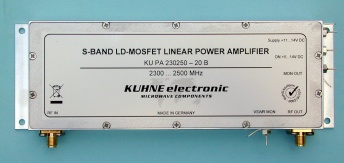


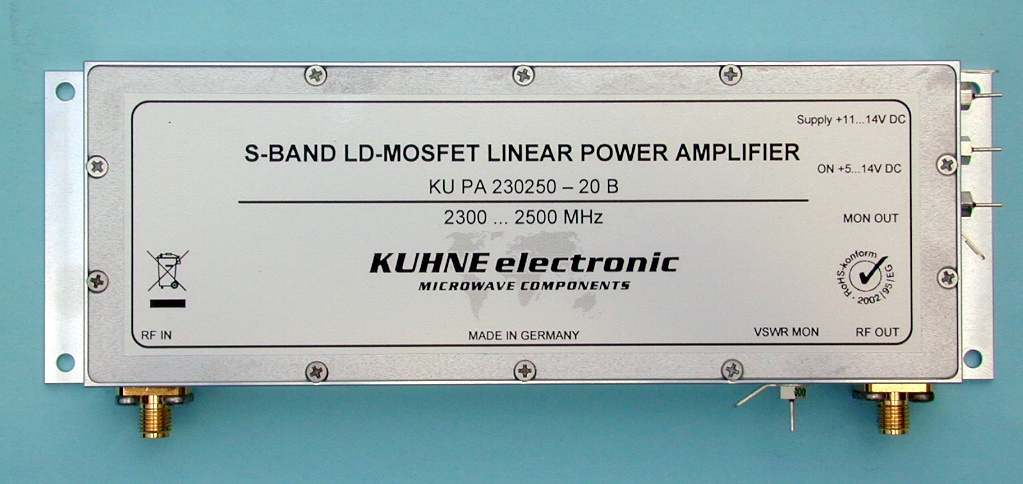

KU PA 230250-20 B, GaAs FET Power Amplifier
2300 ... 2500 MHz • 20 W
Lead time on request
| Frequency range | 2300..2500 MHz |
| Input power for P1dB | typ. 14 dBm |
| typ. +12 dBm | |
| Maximum input power | +17.5 dBm |
| Output power P1dB | typ. 44 dBm, min. 43 dBm (CW) |
| typ. 25 W, min. 20 W (CW) | |
| Output power COFDM (1) | typ. 39 dBm, min. 37.7 dBm |
| typ. 8 W, min. 6 W | |
| Gain (small signal) | typ. 31 dB, min. 30 dB |
| Gain flatness (small signal) | +/-0.5 dB (typ.) |
| Harmonic rejection | typ. 60 dB, min. 55 dB @ 43 dBm |
| IM3 (2) | min. 40 dBc @ 40 dBm PEP (2) |
| Efficiency | min. 20 % @ 43 dBm (CW) |
| Input return loss (S11) | min. 13 dB |
| ON voltage | +5 ... 14 V DC |
| Supply voltage | +11 ... 14 V DC |
| Quiescent current | typ. 7.3 A |
| Current consumption | typ. 7.5 A |
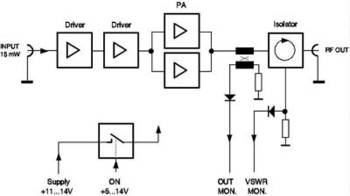
| Forward detection | yes (diode detector) |
| Reflected power detection | yes (diode detector) |
| Operating case temp. range | -20 ... +55 °C |
| Input connector / impedance | SMA-female / 50 ohms |
| Output connector / impedance | SMA-female / 50 ohms |
| Case | milled aluminium |
| Dimensions (mm) | 178 x 60 x 20 |
| Weight | 350 g (typ.) |
| (1) | Measured with QAM 64, single carrier, EVM: 2% |
| (2) | Measured 2-tone, frequency spacing: 1 MHz |
- GaAs FET technology
- High linearity (class A operation)
- Good harmonic rejection
- Isolator for protection against high VSWR
- Reverse polarity protection
- Monitor outputs for forward and reverse power detection (DC voltage)
- ON / OFF control with DC voltage (ON at 5 ... 14 V)
- Multichannel Multipoint Distribution Service (MMDS)
- Digital broadcast systems (DVB-T, DVB-S)
- COFDM systems using modulation types QPSK, QAM
- Analog transmission systems
Please notice the following:
- The technical specifications refer to room temperature.
- The power amplifier doesn’t contain any coaxial relays.
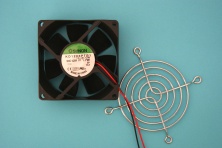
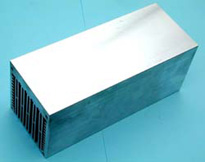
- The recommended combination of heat sink and fan(s) is only specified for an ambient temperature of 25 °C.
- Further information about dimensioning of heat sinks is available on our FAQ site.